
You can work long hours, deliver excellent service, and stay busy—and still struggle to pay your business’s bills.
When your books are months behind or your financial decisions depend entirely on your bank balance, it becomes harder to recognize problems early. Unpaid invoices, rising expenses, and jobs that barely cover their costs can quietly put pressure on your business.
Bookkeeping gives you information you can use to respond before those problems become harder to manage.
What does the research actually show?
It would be misleading to say that most businesses fail because of poor bookkeeping. Business closures have many causes, and the research cited here doesn’t establish that claim.
What the evidence does show is that financial pressures are common.
In the Federal Reserve Banks’ 2025 Report on Employer Firms, based on the 2024 Small Business Credit Survey:
- 75% reported rising costs as a financial challenge.
- 56% reported challenges paying operating expenses.
- 51% reported challenges with uneven cash flows.
These findings came from a nationwide, nonrandom sample of small businesses with employees that were operating or temporarily closed—not a study of why businesses failed. Read the Federal Reserve report.
The following year’s report found that meeting operating expenses remained the most common reason for seeking financing, cited by 56% of financing applicants. Borrowing for operating costs doesn’t necessarily indicate poor management, but it shows how important day-to-day funding needs can be. Read the 2026 report.
My practical takeaway: when costs and payment timing are creating pressure, current financial records give you a better foundation for making decisions.
Your bank balance doesn’t tell the whole story
Imagine a service business with $12,000 in checking. That might feel comfortable until the owner considers $7,000 in upcoming payments and $4,000 being held for taxes.
In this simplified example, only $1,000 remains before considering any additional needs.
A bank balance tells you how much money is in an account at a moment in time. It doesn’t explain every upcoming obligation, whether your work is profitable, or when customers will pay.
Current books, combined with a list of upcoming payments and expected collections, help you see that broader picture.
A busy business can still be undercharging
Full schedules and growing sales can feel like proof that everything is working.
But consider a hypothetical service job billed at $1,000. If direct costs total $850, only $150 remains to contribute toward overhead and profit. That amount still needs to help cover costs such as insurance, software, administration, and other expenses not included in the job’s direct costs.
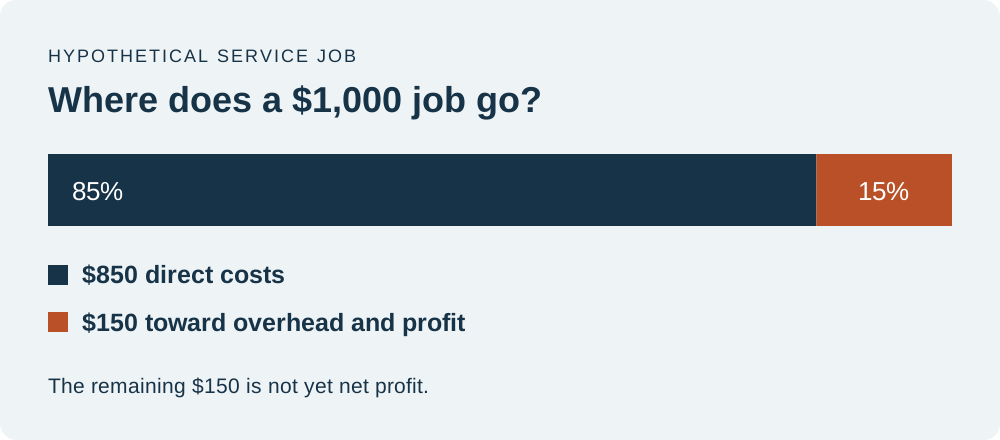
If those costs aren’t tracked consistently, an owner may keep accepting similar work without realizing how little it contributes.
Accurate bookkeeping can support better pricing decisions. Where appropriate, tracking income and direct costs by job or service helps you compare the work that keeps you busy with the work that supports your business.
Late invoices and slow collections can create a cash squeeze
For oilfield consultants and other service providers, the work may be completed well before the payment arrives. Meanwhile, fuel, insurance, equipment payments, and other bills continue.
A useful bookkeeping routine helps you identify:
- Completed work that still needs to be invoiced.
- Customer balances that are overdue.
- Payments received but not applied correctly.
- Bills coming due before expected customer payments.
These records don’t guarantee that customers will pay on time. They help you follow up and plan with better information.
Some businesses have little room for a disruption
A 2016 JPMorgan Chase Institute study, using 2015 transaction data from approximately 597,000 small businesses, found a median cash buffer of 27 days. That measured how long cash balances could cover typical outflows if inflows stopped.
This is historical research, not a current estimate for every business. It illustrates how limited a financial cushion can be. Read “Cash Is King: Flows, Balances, and Buffer Days”.
Knowing your regular outflows and upcoming obligations can help you set a reserve goal suited to your business. An unexpected repair or delayed customer payment is easier to plan for when you understand the numbers.
Books that are never reviewed lose much of their usefulness
Even accurately recorded transactions provide limited decision-making value if the owner never reviews the results.
A monthly review should help answer questions such as:
- Is income growing faster than expenses?
- Which costs have increased, and why?
- Are customers taking longer to pay?
- Can the business support another equipment payment?
- Are owner withdrawals putting pressure on upcoming bills?
The IRS identifies monitoring business progress, preparing financial statements, and tracking deductible expenses among the reasons to maintain good records. It also explains that financial statements can help owners manage their businesses and work with banks or creditors. Read the IRS recordkeeping guidance.
Put your bookkeeping to work throughout the year
Start with a routine you can maintain:
- Keep business and personal transactions separate.
- Review and categorize transactions regularly.
- Reconcile bank and credit card accounts to statements.
- Track outstanding invoices and upcoming bills.
- Review your Profit and Loss and Balance Sheet each month.
- Use those records to help plan spending, collections, and cash needs.
If you’re unsure where to begin, my guide to Five Things to Review in QuickBooks Each Month provides a practical starting point.
Good bookkeeping cannot guarantee success or eliminate economic pressures. It can help you recognize financial problems sooner and make decisions with a clearer understanding of your business.
Get clearer numbers before making your next big decision
After 15 years in the oilfields as a MWD and DD consultant and self-employed 1099 contractor, I understand the effort that goes into earning your business income.
At Blackshaw Bookkeeping, I help small service businesses keep organized, CPA-ready records and understand what their numbers are telling them.
If you’re working hard but still unsure where your money is going, schedule a free consultation. I’ll learn about your business and help identify the bookkeeping support you need.